Which EV charging fire safety rules are legal requirements and which are guidance?
Fire safety guidance can feel overwhelming because not everything you read is a legal requirement. Here is how to tell the difference and what actually applies to your building.
What the law requires: All electrical work must comply with BS 7671. Your fire risk assessment needs updating under the Regulatory Reform (Fire Safety) Order 2005. Where cables pass through fire walls, they need fire rated seals per BS 7671 Regulation 527.2. These are non-negotiable.
What the government recommends: The OZEV guidance T0194 for covered car parks was published in July 2023. It provides sensible frameworks for risk assessment, charger spacing, and safety measures. Insurers increasingly reference OZEV T0194 and Loss Prevention Council technical bulletins. Some policies now mandate specific provisions such as enhanced suppression systems or thermal monitoring. We recommend checking your building insurance early because insurer requirements may exceed building regulations. We can help you understand what your policy requires.
Charger Placement and Clearances
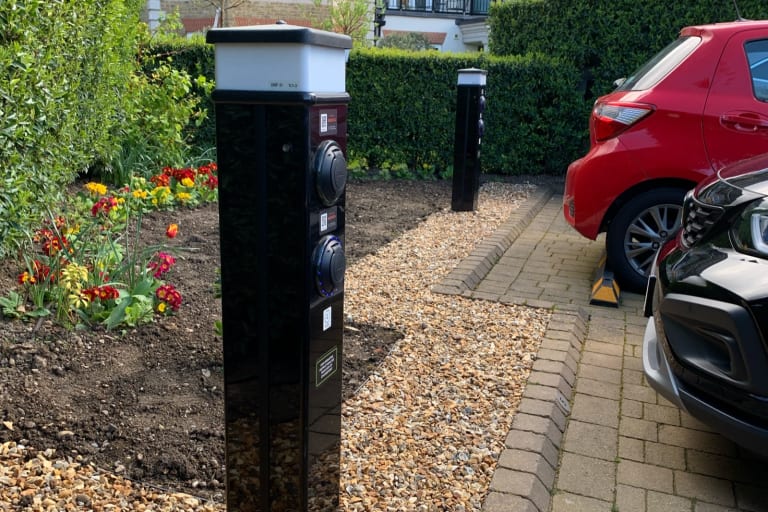
Positioning chargers correctly is mostly common sense. Industry guidance recommends chargers be located at least 10 metres from combustible walls and at least 7.5 metres from unprotected glazing. Wall mounted chargers should not block fire exit routes or make it difficult to reach extinguishers and hose reels.
In enclosed car parks, spreading chargers across the space rather than clustering them together limits the affected area if anything goes wrong. OZEV guidance requires sufficient space for safe vehicle manoeuvring but does not prescribe a specific minimum distance between chargers. Your fire risk assessor will confirm the layout for your building. We design layouts that balance convenience with safety.
What extra fire safety does EV charging in an underground car park need?
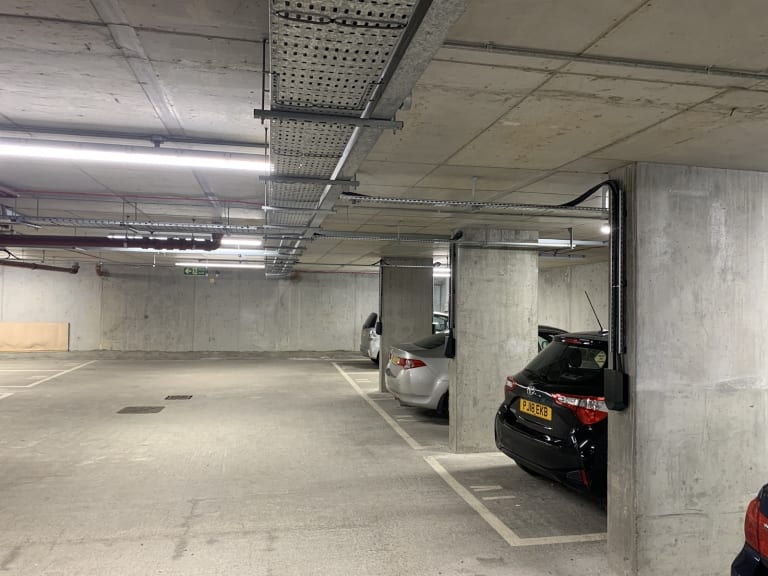
Underground and basement car parks need more attention because smoke and heat behave differently in enclosed spaces. The OZEV 2023 interim guidance provides a clear framework.
Ventilation matters for smoke extraction. Mechanical smoke extraction systems must achieve minimum 10 air changes per hour during a fire event. Day to day ventilation typically operates at 3 to 6 air changes per hour to manage CO levels. Natural ventilation for open sided car parks requires permanent openings of at least 1/40th of floor area per Approved Document B. The good news is that EV charging produces no exhaust fumes, so you are only planning for the unlikely fire scenario.
Fire compartmentation protects escape routes. Where cables pass through fire rated walls or floors, intumescent seals maintain the required fire resistance rating. This can range from 30 to 120 minutes depending on your building type. BS 7671 Regulation 527.2 requires openings to be sealed to restore the original fire resistance. This is standard practice for any electrical work in compartmented buildings.
Detection systems may apply. Heat detectors for car parks should have a static response temperature of at least 29 degrees above the average ambient temperature (typically 57 to 68 degrees in practice). Detectors must be positioned 25 to 150 mm below the ceiling per BS 5839-1. Some underground car parks also require water based suppression systems per BS EN 12845. Your fire safety engineer will confirm the right detection system for your car park.
System integration adds an extra layer. Modern chargers can integrate with your Fire Alarm Control Panel. If the detection system activates, chargers isolate automatically, ventilation kicks in, and alarms transmit. This coordination happens in the background.
How likely is an EV fire while charging in a car park?
EVs are statistically much safer than petrol vehicles when it comes to fire. Data from Sweden’s Civil Contingencies Agency shows combustion vehicles are more than 20 times more likely to catch fire than electric vehicles, after accounting for market share differences.
Battery thermal runaway during charging is extremely rare because modern EVs and chargers include multiple protective layers. The vehicle’s Battery Management System monitors cell temperature and voltage continuously. The charging equipment detects fault currents and disconnects. RCD devices provide an additional layer of protection against residual currents. This redundancy makes incidents during properly installed charging nearly impossible.
Building managers should include EV charging in their fire risk assessments. Fire and rescue services have specific guidance for the rare EV battery fire scenario. We provide all the documentation you need to support your assessment and demonstrate due diligence.