When does the law require EV chargers in apartment buildings?
Since June 2022, Part S of the Building Regulations applies to new residential buildings with associated parking. The requirement is one charge point per dwelling with associated parking. If there are fewer parking spaces than dwellings, one charge point is required per parking space. Cable routes must be installed in additional spaces where the building has more than 10 parking spaces and there are more spaces than dwellings.
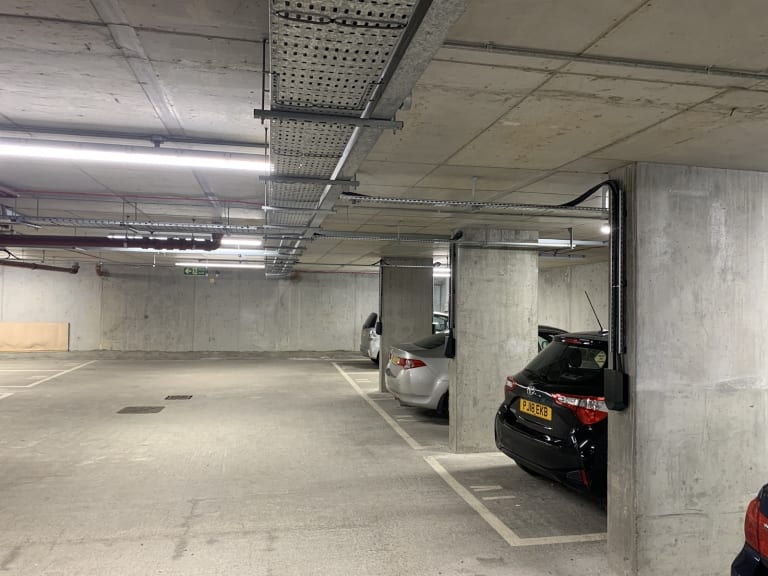
These requirements are subject to a £3,600 average connection cost cap per charge point. Covered car parks are exempt from active charge point requirements due to fire safety considerations around lithium ion battery risks in enclosed spaces. Developers install cable routes only in these areas, ready for future use. We design around these requirements as standard.
Part S applies to new builds, material changes of use, and major renovations as defined in the Building Regulations 2010. All installations must comply with BS 7671 and the Smart Charge Points Regulations 2021. We handle all compliance and DNO notification as part of every project.
Tenant Requests for EV Charging
Tenants can request EV charger installation. There is no statutory right to compel a landlord to install one. However, tenants do have a legal right to install a charger at their own expense, subject to landlord consent. Under the Landlord and Tenant Act 1927 Section 19, landlords cannot unreasonably withhold consent to improvements in most tenancies. This protection does not apply where a lease contains an absolute prohibition on alterations.
With a growing number of flat dwellers now considering EV charging when choosing a home, many landlords are more willing to approve requests. This is particularly true when grants are available to offset costs. We often help navigate these conversations and explain the options to both sides.
Why Landlords Are Installing Anyway
Even without a legal requirement for existing buildings, landlords are installing EV chargers for practical reasons.
Tenant attraction: As EV adoption grows, charging facilities are becoming an increasingly important factor for renters and buyers. Research shows 76 percent of UK homes with EV chargers have higher property values compared to similar properties without them.
Property value: Buildings with charging infrastructure have a competitive advantage in the rental and resale market. Landlords who install now are positioning their properties ahead of growing demand.
Future proofing: As EV adoption rises, the expectation of charging facilities will become standard. Buildings without infrastructure may become less desirable.
Can landlords get a grant for EV chargers?
Yes. Landlords, RMCs, and freeholders can claim the Residential Landlord Chargepoint Grant, up to £500 per socket, capped at 200 sockets a year. Residents can separately claim the Flats and Renters Grant covering up to £500 per socket or 75 percent of costs, whichever is lower. Both schemes run to 31 March 2027.
What can a tenant do if the landlord refuses an EV charger?
If you are a tenant whose landlord has refused an EV charging request, there are still options. You may have the right to install a charger at your own cost, subject to landlord consent. Under most tenancies, consent to improvements cannot be unreasonably withheld.
You can also present the grant funding available. As a resident, you can claim up to £500 per socket through the Flats and Renters Grant. Your landlord can separately claim up to £500 per socket through the Residential Landlord Chargepoint Grant, covering 75 percent of the cost. The remaining 25 percent is typically a modest outlay given the property value benefit. We often help tenants put together proposals that make it straightforward for landlords to say yes.