What Permitted Development Actually Covers
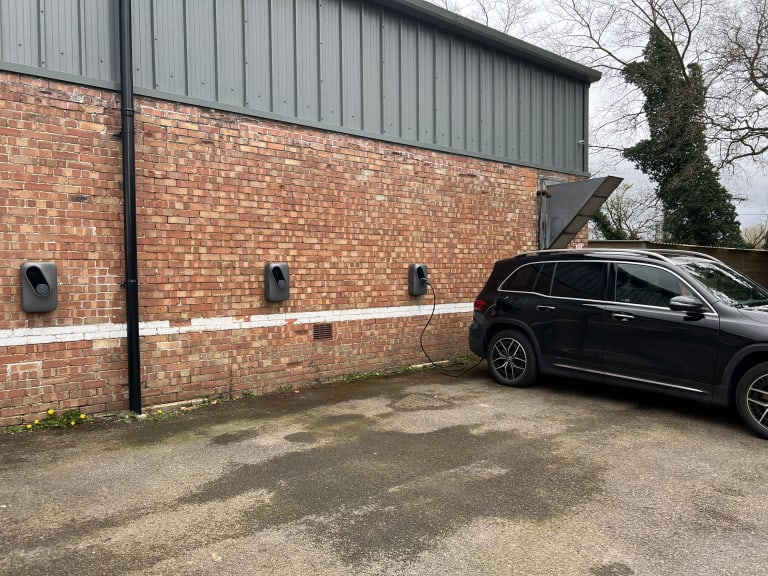
The Town and Country Planning (General Permitted Development) (England) Order 2015 allows most EV charger installations on commercial premises without a planning application. This covers wall mounted chargers (Class D) and freestanding upstands (Class E) in car parks, on building walls, and on private land.
There are specific conditions your installation must meet. The good news is that most standard chargers already fall within these limits.
- Wall mounted charger casings must not exceed 0.2 cubic metres in size
- Freestanding upstands must not exceed 2.7 metres in height
- The charger must not be within the curtilage of a listed building or on a scheduled monument site
- When no longer needed, the wall or land must be restored to its previous condition
If your site is a standard office, warehouse, retail unit, or business park, permitted development almost certainly applies. From 29 May 2025, the rules were updated to remove some restrictions, including the previous two metre from highway rule. Limits and exclusions still apply, but the process is now simpler for most workplaces.
When Planning Permission Is Needed
Permitted development rights do not apply within the curtilage of a listed building. This means not just the building itself but the surrounding land within its boundary. Listed building consent may also be required for any external alterations. This sounds complicated, but it is something we identify early in the survey process.
Conservation areas do not automatically require planning permission for charger installations. Permitted development can still apply. However, some local authorities use Article 4 directions to remove these rights in specific areas. If your site falls within one, a planning application is needed. A Lawful Development Certificate can confirm your rights if there is any doubt.
Larger charging hubs with associated infrastructure such as new substations, major equipment housing, or canopy structures may fall outside the standard GPDO classes. We assess this during the site survey and advise on the right route.
We handle the planning check as part of every project. If permission is needed, we flag it early so it does not delay the installation timeline.
The Workplace Charging Scheme and Planning
The Workplace Charging Scheme grant does not add any planning requirements beyond what already applies. It focuses on installer eligibility, voucher applications, and technical standards. Planning compliance is separate from the grant. We help you identify whether planning approval is needed during the site survey, but the legal responsibility to comply sits with the site owner or occupier.