Public Charging Networks
The UK has over 87,000 public charge points across more than 45,000 locations. The network is growing rapidly, with a new charger added every 33 minutes on average. Rapid chargers are increasingly common in supermarkets, retail parks, and service stations. Many flat dwellers treat these like petrol stations. Top up while shopping or during other activities.
Costs are higher than home charging. Public rates typically run 40 to 80p per kWh versus 20 to 30p at home. But you avoid all infrastructure investment.
Workplace Charging
If your employer offers workplace charging, this can replace home charging entirely. Many companies provide free or subsidised charging as an employee benefit. The Workplace Charging Scheme provides grants for businesses to install chargers.
Check with your employer or HR department. If charging is not available, suggest it. The grants make installation affordable for businesses.
On Street Residential Schemes
Some local councils offer on street charging for residents without off street parking. These schemes install lamp post chargers or dedicated kerbside units on residential streets. You typically apply for a permit to use the charger nearest your home.
Coverage varies significantly by area. Westminster has over 2,000 lamppost chargers. Camden approved 500+ new chargers in October 2025 and will exceed 1,000 total. Check your council website for availability.
Community Charging Hubs
Some areas have community charging locations. These are dedicated car parks with multiple chargers available to local residents. They operate like public chargers but are specifically located to serve residential areas without private parking. Over 670 charging hubs (sites with 6+ rapid chargers) now operate across the UK.
Making It Work
Flat dwellers without parking typically combine charging sources. A common pattern is 80% workplace charging during the week and 20% public rapid charging at weekends. Others use on street schemes primarily with occasional public charging for longer trips.
Choose an EV with sufficient range so you are not charging daily. A vehicle with 250 miles or more of range can go a week or more between charges for typical urban driving.
If Your Flat Has Communal Parking
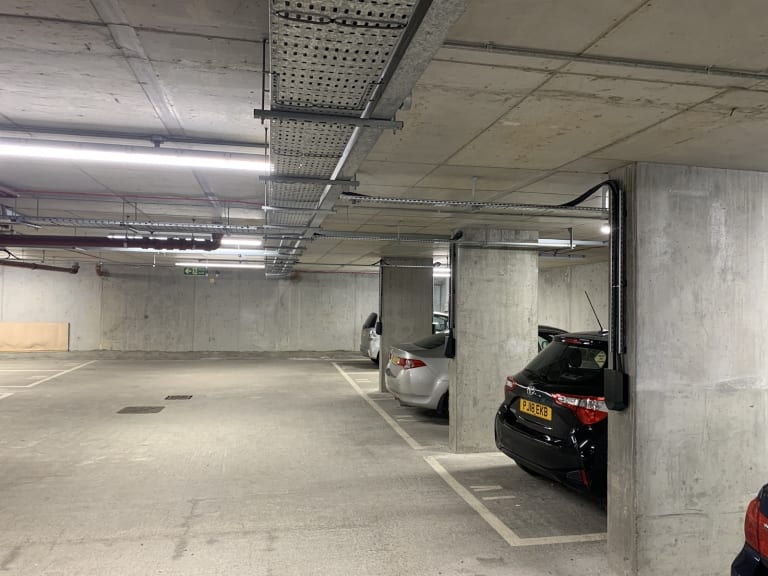
If your building has communal parking but you do not have an allocated space, on site charging may still be possible. Shared charging systems with app based access work well for rotating parking arrangements. This is worth exploring with your building management. We can help assess whether shared charging would work for your building.