How the Integration Works
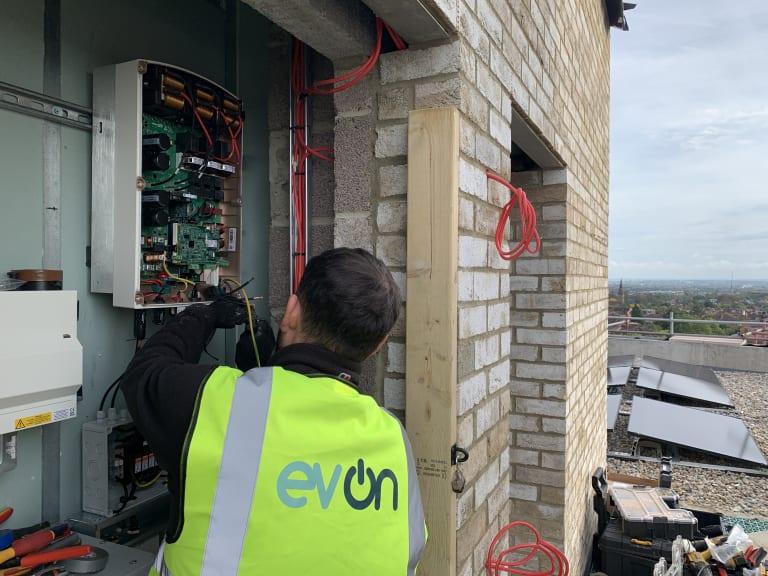
Solar panels generate DC electricity. An inverter converts this to AC, which is what your building and EV chargers use. Our management platform monitors solar generation, battery storage, and grid pricing in real time. It automatically sends solar energy to whichever chargers are active and selects the cheapest available energy source at any given moment.
During peak sunlight hours, your chargers can run partly or entirely on solar power. On cloudy days or during the evening, the system draws from the grid as normal. The switch between solar and grid happens automatically. Drivers plug in as normal and the platform handles the rest.
The platform uses AI to learn driver patterns and forecast daily energy demand. It creates optimised charging schedules that maximise solar self consumption during the day and shift remaining demand to off peak grid rates. This layered approach is how combined systems achieve savings of 40 to 60%, rather than relying on solar alone.
Adding battery storage is optional but useful. A battery captures surplus solar during the middle of the day when generation exceeds demand and releases it for late afternoon charging sessions. The platform optimises battery dispatch alongside everything else.
Financial Benefits
Using solar energy for EV charging is more valuable than exporting it to the grid. Self consumption saves you the full cost of grid electricity for every kWh used on site, typically 25 to 30p per kWh for UK businesses at current rates. Exporting surplus under the Smart Export Guarantee typically pays 3 to 15p per kWh, with the best fixed rate tariffs currently reaching 17.5p. Either way, self consumption is significantly more valuable.
The 100% First Year Allowance for EV charging equipment has been extended to 31 March 2027 for Corporation Tax and 5 April 2027 for Income Tax. Solar PV equipment can qualify for full expensing or the Annual Investment Allowance. Both routes allow businesses to write off the full cost of qualifying equipment against taxable profits in the year of purchase. Speak to your accountant about which relief applies to your combined project.
How Much Solar Do You Need
A useful starting point: every 10kWp of rooftop solar generates roughly 25 to 30 kWh per day on average across the year in southern England. That is enough to provide a meaningful daily top up for 2 to 4 EVs, depending on how far staff commute. A 30 to 50kWp system can offset 40 to 70% of daytime charging demand across the year, with higher coverage in summer and lower in winter.
Commercial solar installations above 3.68kW per phase require a G99 application to the local distribution network operator before installation. We handle this as part of the project. Approval typically takes 2 to 6 weeks, though the DNO may impose export limits on larger systems.
Existing solar systems can be retrofitted to work with new EV chargers. We assess compatibility during the site survey.