Read the Ohme before you touch anything
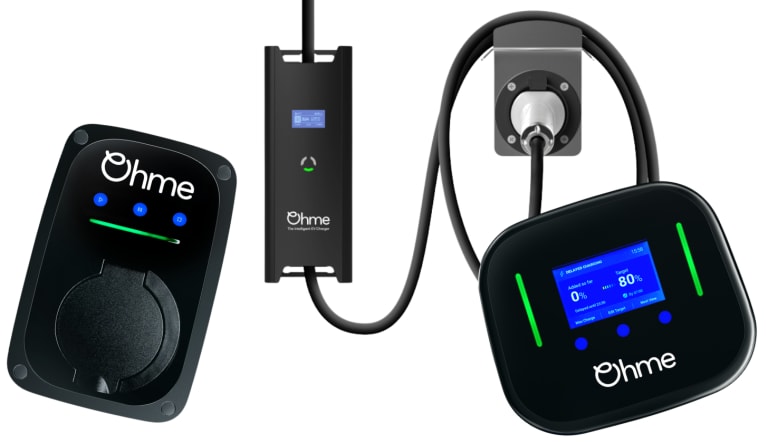
An Ohme tells you a lot if you look. On a Home Pro, read the screen and the two light strips. No light means finished or unplugged, blue means it is waiting for a scheduled delay, solid green means the car is plugged in but not drawing power, green fading in and out means it is charging, and red means an error. On an ePod, read the light bar. Solid green is idle and ready, solid blue is a smart charge scheduled for later, moving blue is charging, blinking green is finished, and a red corner is an error. Every colour is on our ePod lights page and every red state on our red light page.
The point is that blue on either model is not a fault. It is the charger doing what a smart charger does, which is waiting for cheap electricity. A large share of “not working” calls are a charger showing blue at 7pm.
The six causes, in the order we check them
1. A schedule is holding it back. Ohme charges in your tariff’s cheap window unless you tell it otherwise. Every home charger sold in the UK since 2022 has to ship with default off peak hours under the Smart Charge Points Regulations, so a charger that sits and waits at teatime is doing what the law asks of it, not failing. If you plug in at teatime and want charge now, tap Max Charge (on the Home Pro the screen turns from blue to red, and on the ePod hold Play for three seconds). If the car itself has a departure timer or a charging schedule, Ohme’s own guidance is that it will conflict with the Ohme schedule and the car may not charge at all. Turn the car side off and let Ohme run it.
2. The car is limiting the charge. Ohme calls this a Suspended EV message. The charger offered a charge and the car would not take it. The usual causes all sit in the car. An AC charging limit or battery cap (“charge to 80%”), a reduced AC charging or eco setting, or a smart tariff such as Intelligent Octopus Go paired to the car rather than to the Ohme account. Ohme’s own test is a thirty minute Max Charge. If that works, the schedule was the problem. If it does not, try the car on another AC charger or another car on your Ohme.
3. The charger is offline. Ohme runs on a built in 4G SIM. Offline, it does not schedule. It charges the car straight away until full. So offline rarely means “not charging” but it does mean “not charging when you expected”. Ohme’s fix is fifteen minutes off at the breaker. Our offline page has the detail.
4. The mains voltage is out of range. Ohme pauses charging if the supply goes above 253 volts or below 207, the band the UK’s minimum specification for chargers is built around. When that happens the Ohme stops, shows a red flashing error, and restarts on its own once the voltage settles. In some areas that is the network itself spiking, not your house, and we cover how to prove it and who to call on the red light page. On a Home Pro you can read the live voltage by tapping Next View twice. If it happens most evenings, that is your electricity network, and the DNO can test it over a few days. Ohme itself says the DNO is the right call for voltage.
5. The breaker has tripped. Every Ohme has a Type A RCD built in. If it operates, the Home Pro manual says the unit is reset by switching it off and on at the breaker (off, wait five seconds, on) or by unplugging and replugging the car. If the breaker on the fuse board or the separate isolator has tripped and trips again straight away, stop. Something is being protected against, and Ohme’s own guidance is that tripping and loss of power are for your installer, not Ohme.
6. Something on the circuit is interfering. Ohme names one culprit specifically. Powerline network adaptors, the plug in boxes that carry internet over the house wiring, can put noise on the circuit and stop a charge starting. Unplug them and reboot the charger.
What to try when your Ohme charger is not working
- Look at the light or screen and match it to the list above. Blue is waiting, not broken.
- Tap Max Charge (or hold Play on an ePod) and see if it starts. If it does, it was a schedule.
- Check the car for a timer, a charge limit and a reduced AC setting, and clear them.
- Unplug the car, switch the charger off at its breaker on the fuse board for fifteen minutes, switch it back on, and try again.
- If it still will not start, note the exact light or screen message. That is what we need.
When the Ohme has a real fault
A red light that comes back after the fifteen minute sequence. A unit that stays dead with the breaker confirmed on. A Home Pro whose screen or buttons will not respond even after a firmware restore. Those are unit faults, and inside Ohme’s three year warranty a fault in the unit is Ohme’s to put right, on site, at no cost. Outside it, or where you cannot get a visit arranged, we test the unit and the circuit and tell you plainly whether it is worth repairing.
One more honest note. Ohme’s own who to contact guide splits problems between the DNO (voltage, power cuts), the installer (earthing, tripping, loss of power), the car maker (the car’s charging circuit) and Ohme (the charger, the app, connectivity). If you have been passed round that loop and nobody has come out, that is what an independent engineer is for.