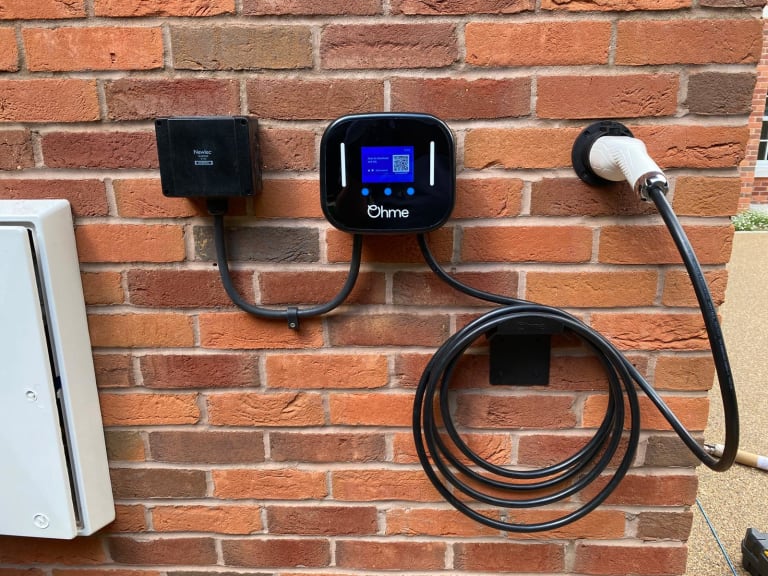
What protection is inside an Ohme, and why it trips
Ohme built a lot of the protection into the unit. From the product manuals:
- A Type A 30 mA RCD with 6 mA DC detection inside the charger. Ohme’s advice to installers is that any RCD upstream on the fuse board should also be at least Type A, because an older Type AC device can be blinded by small DC currents and fail to trip when it should.
- PEN fault detection built in, so no earth rod is needed on a PME supply. If the supply voltage goes above 253 volts or below 207, the charger disconnects the car from live, neutral and earth, and after the voltage recovers it waits five minutes before reconnecting.
- No overcurrent protection in the unit. Ohme expects the installer to provide it, and recommends a 40 amp Type B breaker on the circuit.
Two things follow. First, if the charger’s own RCD operates, the manual says the unit is reset by switching it off and on at the breaker or by unplugging and replugging the car, so a one off trip that clears is not by itself a fault to investigate. Note the time, and if it happens again get it looked at. Second, if the breaker on your fuse board keeps tripping, something upstream of or around the charger is being protected against, and resetting it repeatedly is the wrong move.
Why an Ohme trips the circuit breaker
A DC leak from the car or its cable. The 6 mA DC detection is there for exactly this. A car with a developing fault, or a damaged cable, will trip an Ohme and may not trip an older device on the board. Ohme’s test applies. Try another car on the charger, and the car on another charger.
Water where it should not be. Isolators, junction boxes and connectors that have let water in are a common cause of tripping that starts in wet weather and stops in dry.
A wiring or termination fault on the circuit. Loose neutrals and earths, damaged cable, and boards where the charger circuit was added in a hurry. Ohme’s own who to contact guide sends “tripping, where the breaker is cutting power to the charger” and “issues with earthing” to the installer, not to Ohme, and its tripping page says the commonest causes are the car presenting a small residual current or an inrush current to a sensitive device, which tells you where the answer usually is.
Voltage and PEN. A supply that hovers around the limits can make the charger disconnect and reconnect, which looks like tripping from indoors. That one is your electricity network operator’s to test, over several days, and it is stated on Ohme’s own voltage page.
The wrong RCD upstream. A Type AC device on the board feeding a charger with DC detection can behave oddly. An electrician will easily spot this.
What to do when an Ohme charger keeps tripping
Reset it once. Switch the tripped breaker or isolator back on, or unplug and replug the car. If it holds, note the time and carry on.
If it trips again, or trips every time you plug in, stop resetting it. Leave it off. Try the other car and other charger tests if you can. Then get someone to test the circuit. That is a proper visit with instruments, and it ends with a written result that tells you whether the fault is the car, the cable, the circuit, the supply or the unit.
Do not have the charger opened while it is inside its 36 month warranty. Unauthorised repairs are excluded from the cover, and a unit fault is Ohme’s to fix on site. Ohme also suggests pressing the test button on your RCDs every six months, which is good advice for any home with a charger. Do have the circuit tested by whoever you like. The circuit is not Ohme’s, it is the installer’s work, and it should sit under the warranty they gave you.
If your Ohme installer has gone
A large share of the tripping chargers we attend were fitted by companies that no longer trade, and the owner has been told by the manufacturer to “contact your installer”. That loop is exactly what an independent engineer is for. We test the circuit, the earthing arrangement and the unit, and we tell you which of them it is.