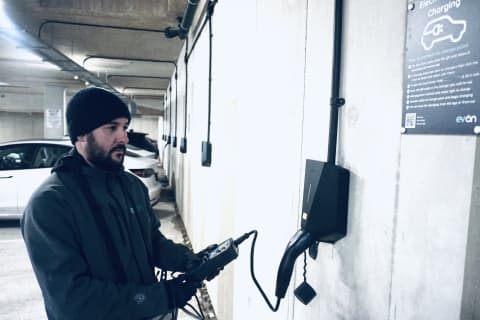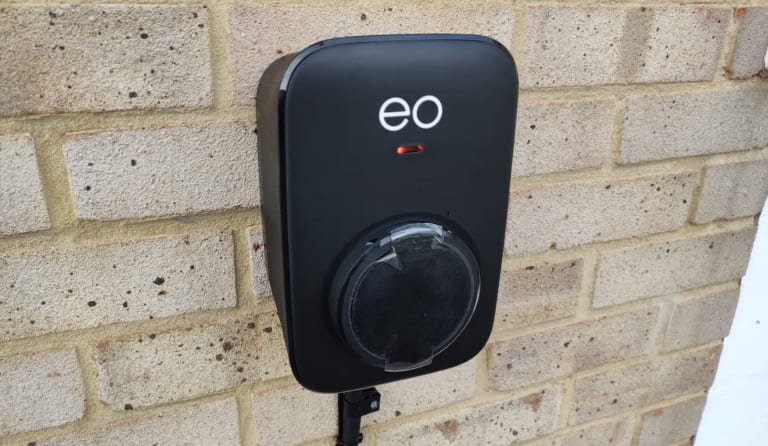
First, which EO have you got?
The older models share one fault system and the Mini Pro 3 uses another, so this matters.
- EO Mini, EO Basic and the original EO Mini Pro (the small square unit, roughly 2018 to 2020) use counted red flashes. The Mini Pro is an EO Mini with a communications module bolted on, and its own guide points you to the Mini LED guide for the lights.
- EO Mini Pro 2 (2020 to 2022, still square) uses the same counted flashes plus a few extra codes.
- EO Mini Pro 3 (the newer rounded unit) does not count flashes. Red, solid or pulsing, is a fault. EO’s guides differ by edition on which pattern they show, so treat any red as a fault.
If you are not sure, the label on the underside or inside the flap gives the model.
EO Mini, Mini Pro and Mini Pro 2: the flash codes
From EO’s own LED guides. The count is short red flashes, then a pause, then the count again.
| Red light | Meaning | What it usually points at |
|---|---|---|
| Solid red (after start up) | Internal fault in the charger | The unit itself. Note these units also show solid red for a few seconds while they power up, which is normal |
| Two flashes | No earth connection | The installation earthing, or a rod that has failed |
| Three flashes | More than 6 mA of DC current leaked to earth | The car or its cable, occasionally the charger |
| Four flashes | Live and neutral connected back to front | The installation wiring |
| Five flashes | Mains supply dropped below 170 volts | Your supply, often a passing dip |
| Seven flashes (Mini Pro 2 only) | Diode test failed | The vehicle |
| Eight flashes (Mini Pro 2 only) | Thermistor fault, no thermistor present | The unit |
| Red then purple (Mini Pro 2 only) | Over current: the car tried to draw more than 130 per cent of the cable rating | The car, or a mismatched cable |
The codes latch. EO designed it so that once a fault is seen, the light keeps showing it until the end of the session even if the fault has cleared, so you know something happened. That is why the first step is always to remove the cable and see whether the light returns to pulsing blue.
EO Mini Pro 3: any red is a fault
The Mini Pro 3 keeps it simpler on the front, and more information is shown within the app. Its power up sequence is solid white, then pulsing blue. Red does not appear at start up on this model.
- EO’s earlier install guide lists pulsing red as the fault condition. EO’s 2025 guide (v3.2.1) and the Hive edition list solid red as the error or fault state. Treat red in either pattern as a fault and look in the ev.energy app for detail if the charger is online.
- Pulsing red and green together is a tamper notification on the later firmware. The unit’s internal tamper sensor has been triggered, usually by a knock or a loose mounting. Not a charging fault, but worth a look.
The Mini Pro 3 PME variant also has built in PEN fault detection, which shuts the charger down if the supply earth is lost. That is a safety function doing its job, and it needs an electrician to check the supply rather than a reset.
The full set of normal running colours for both models, blue, green, yellow and white, is on our page on what the lights on an EO Mini Pro 2 and Mini Pro 3 mean. This page stays on red.
What EO tells you to do, and what we add
EO’s guide is short. Remove the cable and check the light returns to pulsing blue. If not, switch the charger off at its breaker on the fuse board, wait, and switch it back on. If the fault persists, EO says there is potentially an installation or vehicle issue, and it names internal charger faults too, so it can be the unit.
We would add three things.
Five flashes is often not your charger. A voltage dip in the street can trigger it. If it clears on removing the cable and does not come back, note the time and move on. If it happens most evenings, tell us, because that is a supply pattern worth recording.
Two, three and four flashes are not DIY. No earth, DC leakage and reversed polarity are exactly the faults the charger exists to catch. Do not keep resetting and charging through them.
Solid red on the older units is the one that usually means the charger has failed internally. With EO in administration and no parts for the Mini Pro 2, that is normally a replacement conversation, and we will say so plainly rather than sell you a repair.
If it will not clear
Complete the quick remote survey with the model, the flash count and a photo. Some of these we can call from the description. The rest need a visit, and we carry what is needed to test the earthing, the supply and the unit on the day.