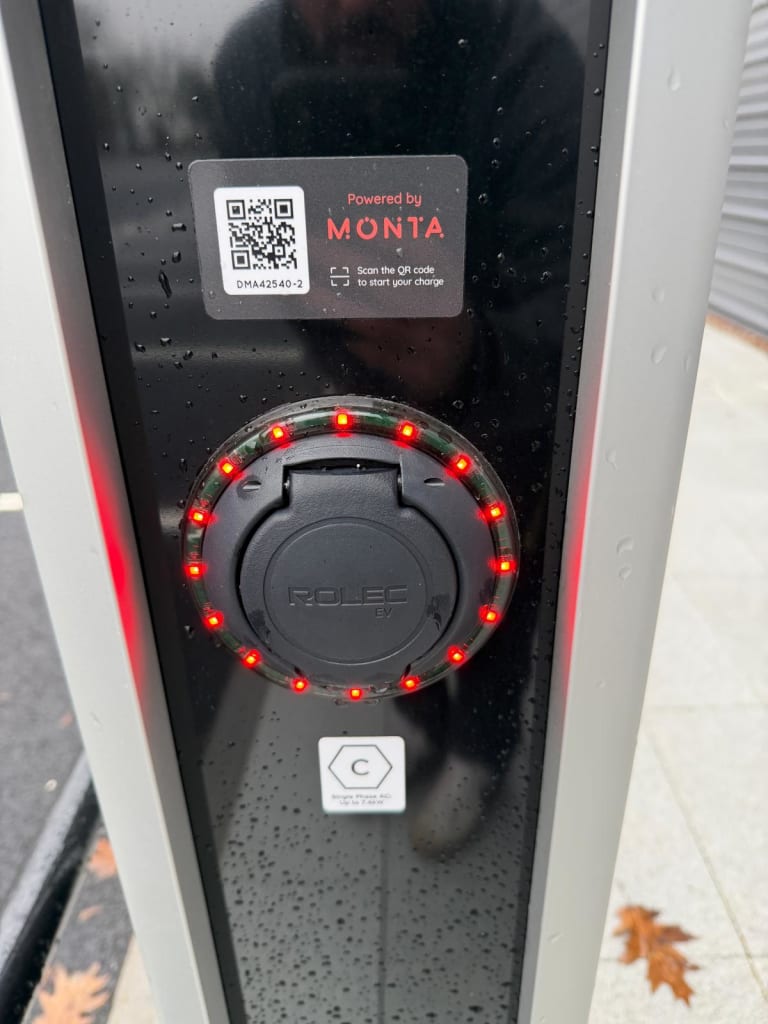
What red generally means
There is no industry standard for charger status lights, which is why searching your brand plus a colour rarely gets you a straight answer.
The one thing that holds across almost every unit is that red means the charger has detected a problem and stopped. It has taken itself out of service deliberately. It does not usually mean the unit is dangerous to stand next to, and it does not mean the charger is destroyed.
Two details change the meaning, and both are worth noting before you call anybody.
Solid or flashing. On most brands a solid red is a fault the unit is holding, while a flashing red is an active or repeating error. Some brands use flash counts as a code.
Whether it clears. A red that clears when you unplug and replug is a session fault. A red that comes straight back on power up is a unit or circuit fault.
The faults that produce it
An earth or residual current fault. The unit has detected leakage and cut the session. This is the protective system working. It can be caused by moisture in the connector, a damaged cable, or a fault in the car.
Overcurrent or over temperature. The charger has pulled back because something exceeded a limit. Common on hot days on a unit in full sun, and usually self clearing.
A connector or lock fault. The charger cannot confirm the connector has locked, so it will not energise. Often a worn latch or debris in the connector.
A communication failure with the vehicle. The charger and car could not complete their handshake. Frequently clears on a retry.
A protective device. An RCD or RCBO has operated, on the circuit or inside the unit. This is the most frequent one we attend, and it does not clear by retrying.
A supply disturbance. A spike or dip on the incoming supply can knock a sensitive unit over. Often clears on a power cycle, and repeats if the supply is the underlying problem.
What you can safely try
Unplug, wait thirty seconds, and plug back in. A large share of red lights are single session faults that clear on a retry.
Look at the connector with the cable unplugged. Check for debris, moisture, burning or discolouration on the pins. Clean debris out gently, with nothing wet, and do not force anything.
Check your consumer unit for a tripped device on the charger circuit.
Check the manufacturer app. Most smart chargers report a plain English fault there, and it is far more useful than the LED. It will also tell you whether the unit is online, because a charger that has lost its connection can show a fault when nothing is physically wrong.
Try the car on another charger. If it fails there too, the fault is the vehicle.
When to stop and call somebody
Stop if you see or smell burning, if there is visible damage to the cable or connector, if the unit is hot, or if there is water inside the enclosure.
Stop if the protective device trips again after one reset. That device is telling you something on the circuit is wrong, and resetting it repeatedly removes the protection without removing the fault.
Stop if the red returns immediately every time you power the unit up. That is not a session fault.
Brand codes
Zappi, Easee, Ohme, Hypervolt, Pod Point and Rolec all use different indicator schemes, and several publish a code list in their app or manual rather than on the unit.
Before calling anybody, it is worth finding the fault code in the app rather than describing a colour. An engineer who knows the code arrives with the right part far more often than one who has been told the light is red.