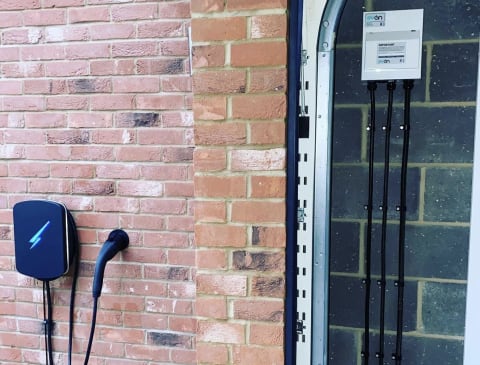
What a Standard Installation Includes
A standard installation is a short cable run from your fuse board to an outside wall, on a supply with capacity to spare. It covers the charger, the cabling, the protective devices, testing, certification and app setup. Done in a morning on most homes.
| Scenario | Typical cost |
|---|---|
| Standard install, mid range smart charger | £962 to £1,250 |
| Premium solar charger (Zappi, Hypervolt) | £1,100 to £1,500 |
| Long cable run or awkward routing | Add £100 to £300 |
| Fuse board upgrade needed | Add £300 to £500 |
| Trenching across a driveway or garden | Add £300 to £700 |
Prices are UK market ranges, VAT included. Yours comes down to one thing, the survey.
What Pushes the Price Up
The charger itself is only half the story. The other half is your house.
Distance matters most. Every extra metre between your fuse board and the charging spot adds cable, containment and labour. A meter cupboard at the front and parking at the back is the classic cost adder.
Older fuse boards sometimes have no spare way, or need updated protection before a charger can connect. If the main fuse needs upgrading, your network operator handles it, often free, sometimes not. And if the cable has to cross a driveway or lawn, groundworks enter the picture. Not ideal, but we quote it upfront rather than surprise you on the day.
We survey before we price. The quote you get is the price you pay.
Grants: Who Still Qualifies
The homeowner grant closed in March 2022, so if you own a house with off street parking there is no government money towards the install. That surprises people, and plenty of outdated pages still suggest otherwise.
Renters and flat owners are the exception. The EV Chargepoint Grant covers 75 percent of the cost up to £500 per socket since the April 2026 uplift, as long as the property has private off street parking. We are OZEV approved and handle the claim as part of the job.
Why the Cheapest Quote Is Rarely the Best One
A charger is a 10 to 15 year fixture carrying 32 amps in all weather. The savings on a cut price install usually come from skipping the survey, undersizing the cable or rushing the certification. The running cost picture matters more. On a smart tariff at around 8p per kWh you pay roughly a third of the standard rate for every mile, and Octopus reports its Intelligent Go customers typically saved around £770 a year against its standard tariff. Getting the right charger for your tariff pays back the install difference quickly.