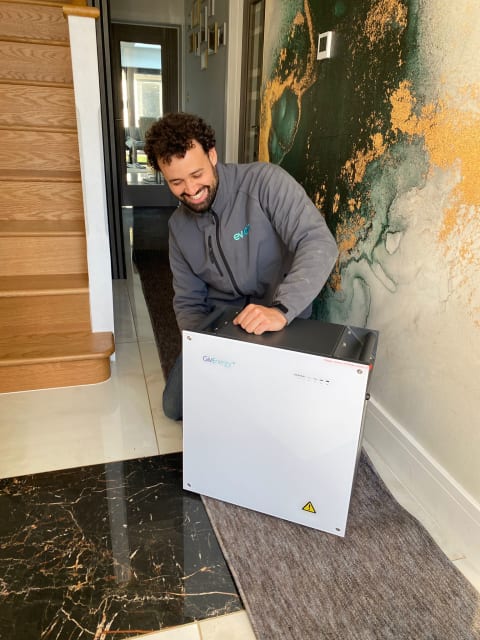
Filling the Battery
A battery charges from one of two sources, and many people use both.
The first is solar. Panels make the most power in the middle of the day, which is often when a home uses the least. Instead of exporting that surplus to the grid for a few pence, the battery stores it for the evening.
The second is the grid, at night. Smart tariffs sell overnight electricity at around 7p to 8p per kWh, while the standard daytime rate sits near 26p. A battery charges while you sleep, then runs the property through the day on the cheap power it banked. No solar panels are needed for this route.
The system decides when to charge on its own, based on your tariff and your usage. You do not manage it day to day.
Powering Your Property
When your home or business draws electricity, the system checks the battery first. If there is energy stored, the battery discharges and supplies your circuits, so you pull less from the grid or none at all.
This is where the inverter earns its place. Your building runs on AC power, the type that comes from the mains. Batteries store energy as DC. The inverter is the translator. It converts power one way when charging and the other way when discharging, so stored energy can run your lights, sockets and equipment safely.
Put simply, the battery is the store, and the inverter is the translator between it and your wiring.
The Same Idea, Homes and Businesses
The principle does not change with scale. A home battery of around 5 to 13 kWh covers the evening and overnight. A commercial system, from tens of kWh upward, covers peak daytime demand or specific loads and can cut expensive peak charges. Charge when power is cheap, use it when power is dear.
One common question is worth a straight answer. Does a home battery keep the lights on in a power cut? Only if it is a battery with backup capability, wired to a dedicated backup circuit. A standard system shuts down safely when the grid fails and does not act as a whole house generator on its own. We can design in backup where you want it.