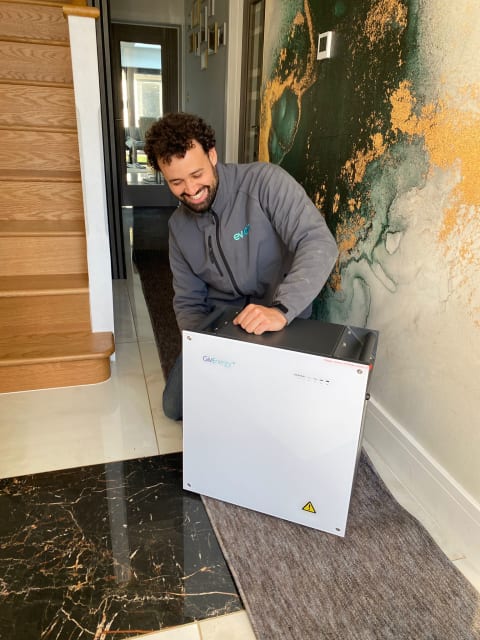
How a battery works without solar
Most people assume you need panels first. You do not. The battery does not care where the cheap power comes from.
On a smart tariff you get a low overnight window. The battery charges while you sleep, filling up at the off peak rate. The best tariffs sit near 7p per kWh, most fall between 8p and 10p, and a few run into the teens. Through the day the battery runs your lights, appliances and everyday load from stored power. You avoid buying at the standard rate when the grid is expensive.
The saving comes from the gap between the two prices. Buy at 8p, use instead of 26p, and every stored unit saves around 18p before efficiency losses. If you already drive an EV, you are probably on one of these tariffs. A battery simply puts the whole house on the same cheap rate as the car.
What you save without solar
The numbers hold up on the night rate route alone. A 10kWh battery cycled once a day on that tariff spread saves roughly £350 to £700 a year. The top of the range needs a tariff with a big gap between night and day rates, cycled fully. Tariffs with a smaller gap, or lighter usage, sit nearer the bottom.
Homes that use a good chunk of power in the evening see the top of that range. Lighter users see the lower end. Either way the saving is real, and it does not depend on the weather. A battery on night rates works as hard in December as in June.
Add solar later and the battery fills itself for free in summer. Many customers start with a standalone battery and add panels down the line. The battery does not need replacing when they do.
The 0% VAT point people miss
Here is the part that surprises people. A standalone battery, fitted with no solar at all, still qualifies for 0% VAT in homes in England, Scotland and Wales until 31 March 2027. The rules changed on 1 February 2024 to cover batteries installed on their own, not just batteries added to solar.
One detail matters. The 0% rate applies to supply and install work carried out by an installer, which covers every battery we fit. Buy a battery on its own without installation and it carries 20% VAT. The route you choose changes the price by a fifth.
After 31 March 2027 the rate is due to return to 5%. Fitting inside the window keeps the battery and the qualifying installation work VAT free. We confirm what qualifies at survey and handle the network operator paperwork as part of every battery storage installation. You do not fill in a single form.